
Enterprise AI Agent Architecture: What It Takes to Replace 15,000 Roles with AI
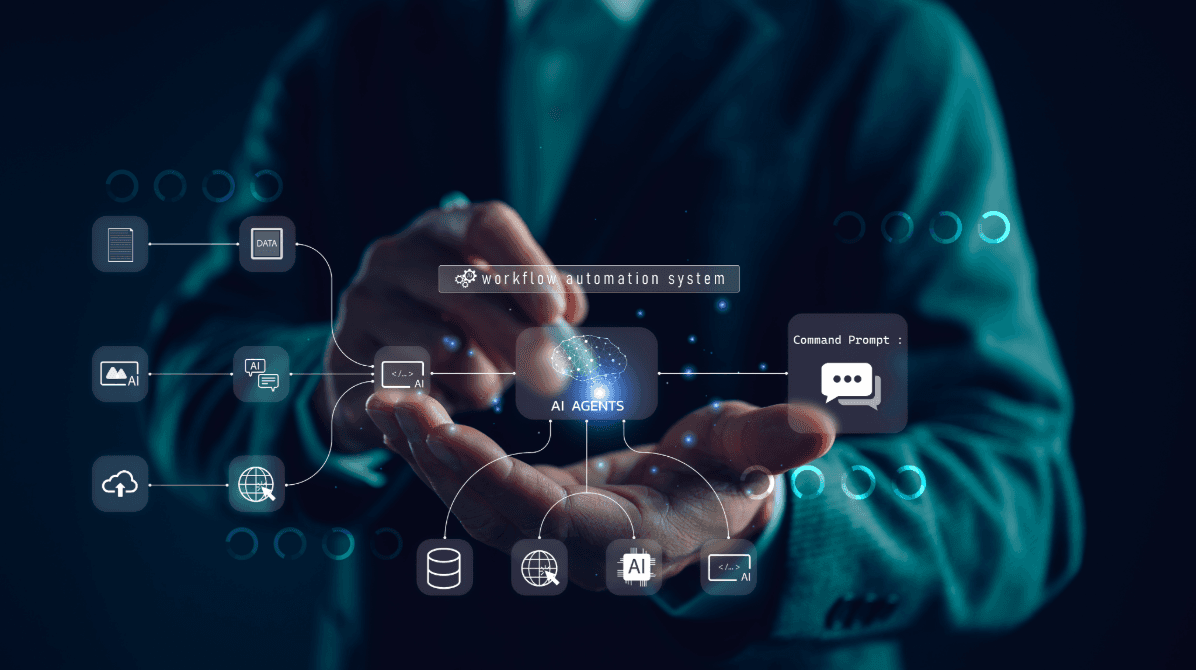
That conversation is happening in boardrooms across every continent. Financial services. Manufacturing. Logistics. Energy. Healthcare administration. Telecommunications. The scale varies. The ambition doesn’t.
And here’s the truth that separates the organizations that will succeed from the ones that will spend hundreds of millions on failed transformations: the technology is ready. The architecture patterns exist. The foundation models are capable. But the path from a 15,000-person operation to an AI-augmented or AI-primary workforce is not a software deployment. It’s an enterprise transformation—and it demands a level of assessment discipline, architectural precision, and operational planning that most organizations have never attempted.
The biggest opportunity here is not only about replacing and enhancing workers with AI and automation. But rather, completely rebuilding enterprise operations around data-connected resolutions where AI agents handle tedious, repetitive, domain-specific manual tasks so that humans can focus on tasks where judgment, governance, rules, and other improvements matter more.
Enterprises that treat AI agents as a new operating architecture instead of simply treating them as a workforce replacement will be able to build a much more durable and resilient operation.
This is the work Cylix Solutions exists to do.
Cylix helps enterprises move from AI ambition to production-ready architecture. Learn more about enterprise AI transformation.
What Is an AI Agent Workforce?
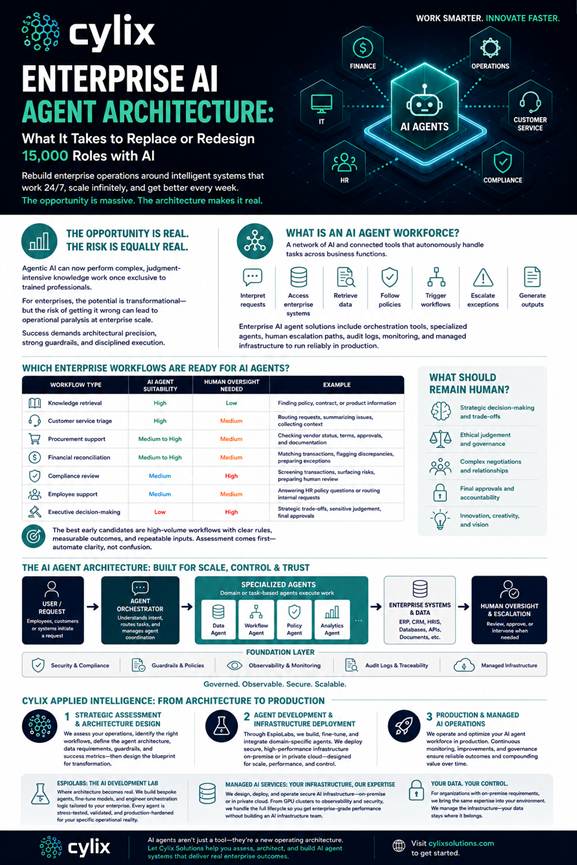
An agentic workforce is a multi-agent system and connected tools that is designed to handle tasks across various business functions autonomously. These agents can:
- interpret requests
- access enterprise systems
- retrieve data
- follow policies
- trigger workflows
- escalate exceptions
- and generate structured outputs for review or action.
At the enterprise level, you want more than a simple chatbot. You want a fully operational AI solution that is made up of various coordination tools, specialized agents, task-based agents, human escalation paths, audit logs, monitoring, and managed infrastructure to reliably run them in production.
This is why the architecture matters.
The Opportunity Is Real. The Risk Is Equally Real.
Let’s be direct about what’s on the table.
Agentic AI (autonomous systems that perceive, reason, decide, and act) has reached a maturity point where it can credibly perform knowledge work that was previously the exclusive domain of trained professionals. Not just repetitive tasks. Complex, judgment-intensive workflows that require context awareness, policy interpretation, multi-system data synthesis, and adaptive decision-making.
For an enterprise running 15,000 employees across multiple departments—finance, operations, procurement, customer service, compliance, HR, and IT—the potential is transformational. An AI agent workforce operates around the clock without shift changes, scales horizontally without recruiting cycles, maintains perfect consistency in policy application, and generates structured data from every interaction that feeds continuous improvement.
The operational economics are staggering. The customer experience implications are profound. The competitive advantage for early movers is potentially insurmountable.
But—and this is the part that doesn’t make it into most vendor presentations—the risk profile of getting this wrong is equally significant. An enterprise that restructures its operations around an AI agent workforce is making a foundational bet. If the architecture is fragile, if the models hallucinate in production, if the agent hierarchy can’t handle edge cases, if data sovereignty requirements are violated, or if the system can’t scale under real-world load, the consequences aren’t a failed pilot. They’re in operational paralysis at enterprise scale.
This is why the assessment, discovery, and architectural design phases aren’t preliminary steps. They are the most critical work in the entire transformation.
Which Enterprise Workflows Are Ready for AI Agents?
Not every workflow needs to be automated right away. Your ideal starting point might not be the most visible process nor the most expensive team. It will most likely be the workflow where rules are clear, data is accessible, guardrails are in place (or risks can be contained), and the outcomes can be measured.
| Workflow Type | AI Agent Suitability | Human Oversight Needed | Example |
| Knowledge retrieval | High | Low | Finding policy, contract, or product information |
| Customer service triage | High | Medium | Strategic trade-offs, sensitive judgment, and final approvals |
| Procurement support | Medium to High | Medium | Checking vendor status, terms, approvals, and documentation |
| Financial reconciliation | Medium to High | Medium | Matching transactions, flagging discrepancies, preparing exceptions |
| Compliance review | Medium | High | Screening transactions, surfacing risks, preparing human review |
| Employee support | Medium | Medium | Answering HR policy questions or routing internal requests |
| Executive decision-making | Low | High | Strategic trade-offs, sensitive judgement, final approvals |
The best early candidates are usually high-volume workflows with clear rules, measurable outcomes, and repeatable inputs. This is why assessment comes before development. If the workflow is not understood, the agent will only automate confusion.
What Should Remain Human in an AI Agent Workforce
The goal of enterprise AI agent design is not to remove humans from every process. That is a weak operating model. The better goal is to place humans where their judgment, accountability, and context matter most.
Some work should remain human-led, human-approved, or human-supervised by design. For example:
- High-stakes decisions with legal, financial, safety, or reputational consequences
- Sensitive customer situations where empathy and judgement matter
- Final approvals for regulated workflows
- Exception handling where the policy does not clearly apply
- Strategic decisions that involve trade-offs, priorities, or business context
- Governance reviews, model evaluations, and escalation design
- Relationship-driven work with customers, partners, employees, or regulators
In a mature enterprise architecture, humans are not completely taken out of the equation. They become supervisors, exception handlers, policy owners, reviewers, and continuous improvement leaders while the agentic workforce handles repeated
Phase One: Assessment and Discovery — Before a Single Agent Is Built
Every enterprise AI transformation begins with the same mistake if left unchecked: starting with the technology and working backward to the problem. Cylix inverts this entirely.
Our Applied Intelligence practice begins every enterprise engagement with a rigorous operational assessment. Not a technology audit. An operational one. We need to understand, at a granular level, how the business actually works before we can architect a system to do that work autonomously.
Workflow Mapping and Decomposition.
For an organization with 15,000 employees across multiple departments, the first task is mapping every workflow that touches the functions under evaluation. Not at the department level. At the task level. What does a procurement specialist actually do each day? What systems do they access? What decisions do they make? What information do they need, from where, and in what sequence? What are the exception paths? What requires human judgment that no policy document captures?
This decomposition produces something that most enterprises have never had: a complete, granular map of their operational logic. Every decision point. Every data dependency. Every handoff between teams. Every escalation trigger. This map becomes the blueprint for the agent architecture.
Criticality and Risk Classification.
Not every workflow carries the same risk profile. A customer service inquiry about store hours and a compliance review of a cross-border transaction exist in fundamentally different risk categories. The assessment phase classifies every workflow on two axes: operational criticality (what happens if this fails?) and autonomous suitability (can an AI agent perform this reliably today, or does it require human oversight?).
This classification determines the transformation roadmap. High-suitability, lower-criticality workflows move first. High-criticality workflows that require autonomous operation get the most rigorous architecture, testing, and fallback design. Some workflows (the ones where the cost of an error is existential) may retain human-in-the-loop oversight permanently. That’s not a failure of the AI. That’s intelligent architecture.
Data Landscape and Sovereignty Analysis.
An AI agent workforce is only as capable as the data it can access and the models it can run. The discovery phase maps every data source the agents will need (ERPs, CRMs, knowledge bases, document repositories, communication platforms, financial systems) and evaluates each for accessibility, quality, structure, and governance constraints.
Critically, this is where data sovereignty enters the picture. For global enterprises operating across the Americas, Europe, and the Middle East, the question of where data lives and where models run isn’t a technical footnote. It’s a regulatory requirement that shapes the entire architecture. We’ll come back to this.
AI agents are only as useful as the data they can safely access. Cylix helps enterprises prepare the data foundations, governance models, and system connections needed for AI agents to retrieve, interpret, and act on business information with confidence. Explore AI and Data Strategy.
Phase Two: The Agent Architecture — Hierarchy, Specialization, and Orchestration
This is where the engineering separates serious implementations from science projects.
The architecture of an enterprise AI agent workforce is not a single model answering questions. It’s a structured hierarchy of specialized agents, each with defined capabilities, clear boundaries, and governed interactions which are orchestrated by systems that manage complexity the way an organization chart manages human teams.
Enterprise AI Architecture at a Glance:
| Layer | Role | Purpose |
| Orchestration layer | Interprets requests and routes work | Decides which agents need to act |
| Domain agents | Handle function-specific workflows | Finance, procurement, HR, compliance, customer operations |
| Sub-agents | Execute narrow tasks | Retrieve data, check records, compare documents, trigger actions |
| Human oversight layer | Reviews, approves, escalates, and improves | Keeps accountability and judgement in the system |
Cylix has applied this type of architecture through the AI Boardroom, a system built around specialized agents working across business functions with human governance built into the workflow.
This layered structure is what separates enterprise AI architecture from basic automation.
For a shorter look at the orchestration, security and cost decisions behind agent deployments, read AI Agents Are Powerful. Building Them Right Is the Real Challenge.
The Orchestration Layer and Foundation Models.
At the top of the hierarchy sits the orchestration layer. This is the system’s central nervous system, responsible for receiving incoming requests, understanding intent, determining which agents or agent teams need to be engaged, managing the workflow across multiple steps, and assembling the final output.
The orchestration layer typically runs on foundation models — large, general-purpose language models with broad reasoning capability. These models provide the contextual understanding and planning ability needed to decompose complex requests into subtasks and route them appropriately. They understand nuance, handle ambiguity, and make routing decisions that account for the full context of the interaction.
For many enterprises, the orchestration layer is the one component where commercial foundation models from major providers can be justified since the reasoning breadth required is substantial, and the volume of orchestration calls (relative to the total agent activity beneath them) makes the per-token economics manageable.
The Cylix AI Fabric connects this orchestration layer with the models, data, tools, and infrastructure beneath it.
Department-Level Agents: The Skilled Specialists.
Below the orchestrator sit department-level or domain-level agents. These are the mid-tier of the hierarchy (agents trained or fine-tuned on specific operational domains). A finance agent. A procurement agent. A compliance agent. A customer operations agent. An HR administration agent.
These agents are skilled across the range of workflows within their domain. The finance agent understands accounts payable, accounts receivable, reconciliation, reporting, and budget management. It knows the policies, the approval chains, the exception handling procedures, and the system integrations specific to the finance function.
Here’s where the architecture makes a critical economic and sovereignty decision: these domain agents often run on self-hosted models.
The rationale is twofold. First, cost. Domain agents handle high volumes of interactions within their area. Running every one of those interactions through a commercial API at per-token pricing would make the economics of an AI workforce untenable at enterprise scale. Self-hosted models, fine-tuned on the organization’s specific domain data and deployed on dedicated infrastructure, dramatically reduce the marginal cost per interaction once the infrastructure investment is in place.
Second, data sovereignty. Domain agents in finance, HR, compliance, and customer operations are processing sensitive data continuously. Customer records. Employee information. Financial transactions. Regulatory filings. For enterprises operating across jurisdictions with strict data residency requirements—Canada’s PIPEDA, the EU’s GDPR, and data localization mandates across the Gulf Cooperation Council—running these workloads on self-hosted infrastructure in controlled geographies isn’t optional. It’s a compliance requirement.
Sub-Agents: Hyper-Specialized Task Executors.
At the base of the hierarchy are the sub-agents. These are purpose-built, narrowly scoped systems designed to do one or two things exceptionally well. They are the scouts dispatched by their parent agents to retrieve specific information, execute specific actions, or perform specific analyses.
A finance domain agent investigating a payment discrepancy doesn’t do everything itself. It dispatches a sub-agent to pull the transaction history from the ERP. Another sub-agent to check the vendor’s payment terms in the contract management system. Another way to search the internal knowledge base for known issues with the payment gateway. Each sub-agent is hyper-optimized for its task, lightweight, fast, reliable, and operating within tightly defined boundaries.
This is where reliability comes from. A sub-agent that does one thing is far easier to test, validate, and trust than a monolithic system trying to do everything. When a sub-agent returns its result, the parent agent synthesizes the findings and makes the decision. The sub-agent doesn’t need to understand the broader context. It just needs to execute its specific retrieval or action flawlessly.
This hierarchical pattern (orchestrator to domain agent to sub-agent) mirrors how high-performing organizations already operate. An executive sets direction. A department head manages the domain. Individual contributors execute specific tasks. The AI architecture follows the same logic, for the same reasons: specialization enables reliability, and hierarchy enables scale.
Why This Architecture Matters for Enterprise Risk.
When an organization is restructuring its operations around an AI workforce, the architecture isn’t a technical implementation detail. It’s the single most important risk decision in the entire transformation.
A flat architecture, where a single model handles everything, is brittle, expensive, and impossible to audit. When something goes wrong, you can’t isolate the failure. When regulations change, you can’t update one component without risking cascading effects. When load spikes, the entire system degrades.
A hierarchical architecture with specialized agents and hyper-focused sub-agents provides isolation, auditability, and graceful degradation. If a sub-agent fails, its parent agent can retry, fall back, or escalate. If a domain agent needs to be retrained for a policy change, the rest of the system continues operating. If demand surges in one department, capacity can be scaled independently without affecting other domains.
For an enterprise betting its operations on this architecture, these properties aren’t nice-to-haves. They’re existential requirements.
Cylix Applied Intelligence: From Architecture to Production
This is the work Cylix Solutions was built for.
Cylix Applied Intelligence is a full-spectrum AI services practice—from strategic assessment through architecture design, model development, infrastructure deployment, and managed operations. We don’t hand enterprises a whitepaper and wish them luck. We build the systems, deploy them on the right infrastructure, and operate them in production.
EspioLabs: The AI Development Lab.
At the core of Cylix’s Applied Intelligence practice is EspioLabs, our dedicated AI development lab. EspioLabs is where the architecture becomes real, where domain-specific agents are designed, where models are fine-tuned on enterprise data, where sub-agent frameworks are built and tested, and where the orchestration logic that ties the entire hierarchy together is engineered.
EspioLabs doesn’t build generic AI products. It builds bespoke agent systems tailored to the specific operational reality of each enterprise client. The procurement agent for a manufacturing conglomerate looks nothing like the procurement agent for a financial services firm—different ERPs, different approval workflows, different compliance requirements, different vendor ecosystems. EspioLabs builds for the specifics because the specifics are where reliability lives.
The lab operates across the full development lifecycle—from initial agent prototyping and prompt engineering, through model fine-tuning and evaluation, to integration testing against live enterprise systems and production hardening. Every agent that ships from EspioLabs has been stress-tested against the workflows it’s replacing, validated against edge cases surfaced during the discovery phase, and benchmarked for accuracy, latency, and cost efficiency.
Managed AI Services: Your Infrastructure, Our Expertise.
For enterprises running self-hosted models, infrastructure isn’t a commodity decision. It’s an architectural one.
Cylix’s Managed AI Services team handles the full infrastructure lifecycle for enterprise AI deployments. Whether the client needs a private AI cloud deployed in their own data center, a dedicated environment in one of our partner facilities, or a hybrid architecture spanning multiple geographies, Cylix designs, provisions, deploys, and operates the infrastructure.
This includes GPU cluster provisioning and management, model serving infrastructure, inference optimization, monitoring and observability, security hardening, and ongoing capacity planning as the AI workforce scales. Our clients get enterprise-grade AI infrastructure without building an AI infrastructure team from scratch.
For organizations with on-premise requirements, whether driven by data sovereignty mandates, latency constraints, or security policy, Cylix’s Managed AI Services brings the same expertise directly into the client’s environment. We manage the infrastructure. The data never leaves their walls.
Global Presence, Local Compliance.
Cylix operates with datacenter partners across the Americas and the Middle East, providing the geographic reach that global enterprises require. An enterprise headquartered in Toronto with operations in Dubai and São Paulo needs AI infrastructure that respects the data residency requirements of each jurisdiction while maintaining a unified agent architecture.
Cylix’s global infrastructure footprint makes this possible. Domain agents handling GCC customer data run on infrastructure within the region. North American operations stay on North American infrastructure. The orchestration layer ties it together seamlessly, routing requests and data through the appropriate geographic and compliance boundaries without the enterprise having to manage the complexity.
From private hosted AI services for organizations that need complete control to fully managed AI operations for those that want to focus on their business rather than their infrastructure, Cylix Applied Intelligence is the single provider covering every layer of the stack.
The 24-Hour Workforce: What Becomes Possible
When the architecture is right, when the assessment has been thorough, and when the agents are built on solid foundations and running on infrastructure that matches the enterprise’s compliance and performance requirements—something remarkable happens.
The business doesn’t just operate more efficiently. It operates differently.
Customer inquiries that previously queued until Monday morning are resolved at 2 a.m. on Saturday. Procurement workflows that took three days of human handoffs are now complete in minutes. Compliance reviews that bottleneck at quarter-end run continuously. Financial reconciliations that consumed entire teams happen in the background every day, with exceptions surfacing the moment they’re detected rather than weeks later during an audit.
The enterprise becomes responsive in a way that human-staffed operations physically cannot be. Not because the humans weren’t capable. Because the constraints of human availability, attention, and processing speed set a ceiling that no amount of optimization can break through.
An AI agent workforce doesn’t have that ceiling. It operates 24 hours a day, 365 days a year. It scales to meet demand without advance planning. It maintains quality under load because quality is a function of architecture, not stamina. And it generates the data to continuously improve itself—every interaction, every decision, every outcome feeding back into the system to make the next one better.
This is what organizations have envisioned for decades. Automation promised it and underdelivered. RPA attempted it and hit a complexity wall. Agentic AI, deployed on the right architecture with the right operational discipline, actually delivers it.
The Cost of Waiting
The risk of waiting is not just that competitors will deploy AI first. The bigger risk is that they will start learning sooner.
Enterprise AI agent systems improve through real operational use. The agents learn from workflows, exception patterns, approval paths, system constraints, customer behaviour, and internal policies. That learning cannot be purchased as a finished product later. It compounds through deployment, monitoring, feedback, and refinement.
A competitor that starts today is not only testing technology. It is building proprietary operational intelligence around its own data, systems, and workflows.
That does not mean every enterprise should rush into full autonomy. It means the assessment phase should start before the pressure becomes urgent. The organizations that move carefully now will have better workflow maps, cleaner data paths, stronger governance models, and more realistic deployment roadmaps when the business is ready to scale.
The cost of waiting is not missing out on a trend. It is falling behind on the internal learning required to make AI work safely in production.
Start the Conversation
Cylix Applied Intelligence—from EspioLabs’ AI development lab to our Managed AI Services team and our global infrastructure network—exists to take enterprises from evaluation to production.
If your organization is assessing an AI-driven workforce transformation, we’d welcome the conversation. Not a demo. Not a pitch. A serious conversation about your operations, your constraints, your ambition, and the architecture required to get there.
Cylix Solutions is a global AI infrastructure and services provider, delivering private hosted AI, managed AI services, and enterprise agent development through its Applied Intelligence practice and EspioLabs AI development lab. With datacenter partners across the Americas and the Middle East, Cylix serves enterprises that demand performance, sovereignty, and reliability at scale. Visit cylixsolutions.com to learn more.