
Cylix AI Fabric
Enterprise AI Agents,
Built to Scale.
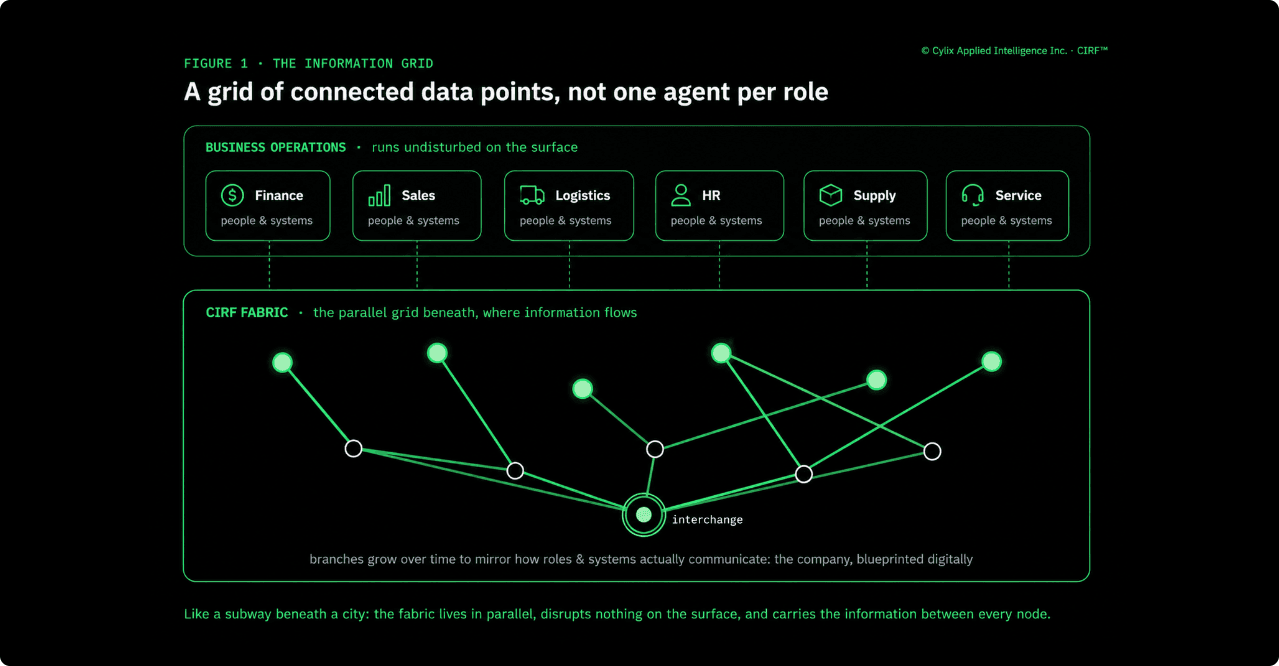
The Cylix AI Fabric is the governed layer between your agents and your data, models, and tools. It routes every unit of work to its cheapest correct path, keeps your data in its home jurisdiction, and turns each new AI capability into a reuse of the foundation rather than a rebuild of it.
No commitment · 30 minutes · Real numbers
At a Glance
Agent work designed to resolve without ever reaching a frontier model.
Corporate data stays in its home jurisdiction. Compute travels to the data.
Policy substrate governing what every agent may do and how its work is routed.
Security and governance by design.
The Problem
Most AI Programs Stall.
The Models Are Rarely Why.
Getting one agent to work in a demo is easy. Getting a fleet of agents to work together, in production, across real data and real compliance boundaries, at a cost your CFO will re-authorize next year, is where the majority of enterprise initiatives stop. Four failure modes account for nearly all of it.
The frontier tax
The path of least engineering resistance sends every task to the most capable model available. It works in a pilot and it is ruinous at scale. Classifying a ticket, extracting a field from an invoice, and looking up an order status do not need frontier reasoning, yet the default architecture pays frontier prices for all three.
Rebuilding every time
When each initiative provisions its own connectors, retrieval stack, authentication, and model routing, the tenth capability costs as much as the first. There are no economies of scale because nothing is shared. A sound foundation should make capability ten dramatically cheaper than capability one.
Governance bolted on late
Memory, tool access, and autonomous reasoning each widen the attack surface. Retrofit governance after the agents already work and the organization is left choosing between shipping what it cannot audit and halting a program it has already funded. Security is a day-one decision.
Data gravity ignored
Enterprise data lives in systems of record under real residency and regulatory constraints. Architectures that assume data can be copied into whatever cloud the model runs in collide with sovereignty rules, egress costs, and governance mandates. For multi-jurisdiction operations this is often what kills an otherwise sound design.
The Core Idea
Every Unit of Work Takes
the Cheapest Correct Path.
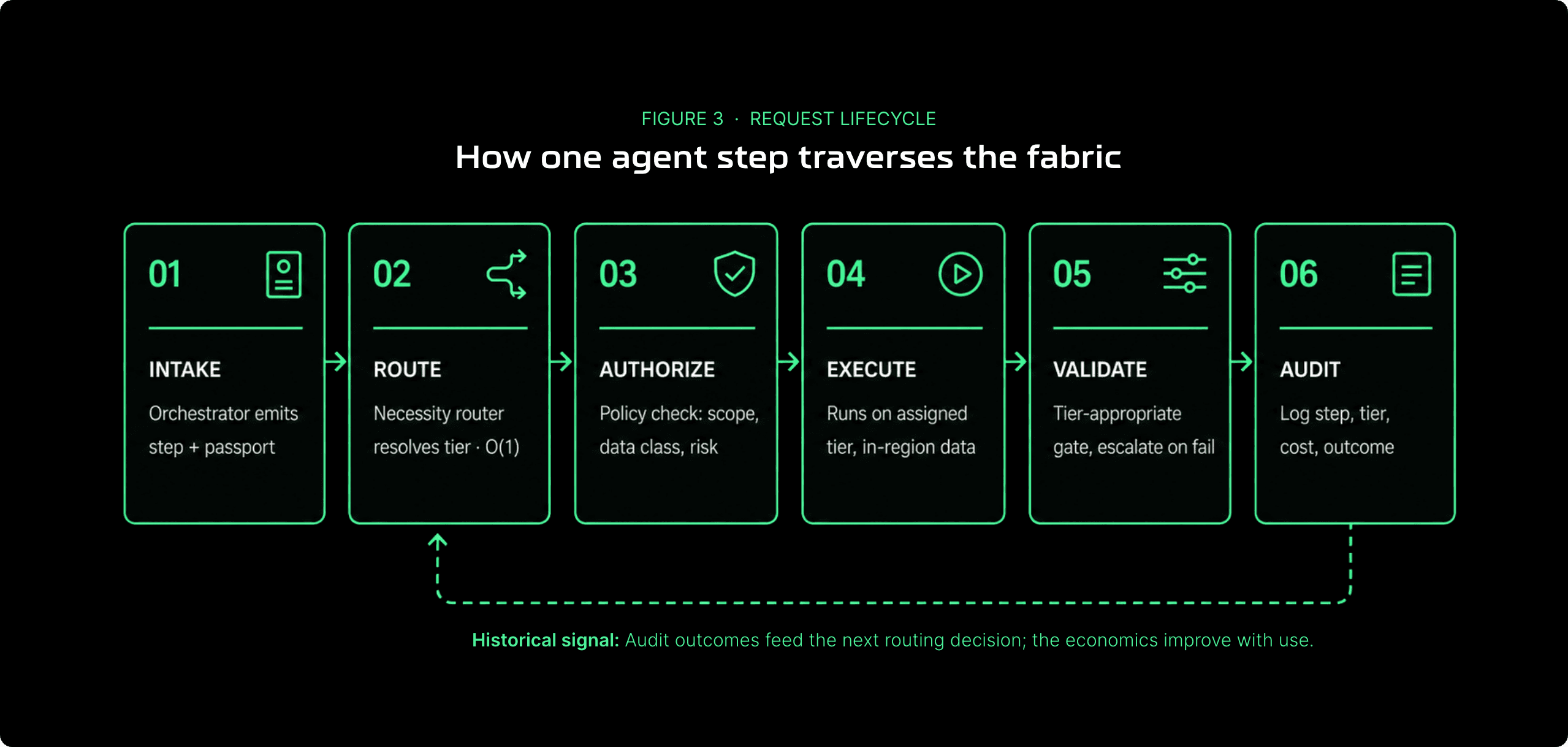
Producing one correct answer with a frontier model is neither difficult nor scarce. Producing millions of correct answers a day, in jurisdiction, under governance, at a defensible unit cost, is the real problem. The fabric makes that decision millions of times a day: for each unit of work an agent must perform, what is the least costly path capable of performing it correctly? Cheap paths are the default, expensive reasoning is reserved for the fraction of work that genuinely needs it, and every result is validated before it is trusted.
Illustrative and directional rather than a guarantee. The exact split depends on the shape of your workload. The principle does not change: the overwhelming majority of enterprise agent work is repetitive, structured, and deterministic, and paying frontier prices for it is the single largest source of avoidable AI spend at scale.
Why It Holds Up
Built for Scale, Security,
and Cost Control.
These are not three separate features that happen to ship together. They are three consequences of the same architectural decision.

Scale
Add the hundredth agent as easily as the first
- Every new capability reuses the same data connections, security model, routing, and orchestration.
- Agents are composed from a shared library of governed building blocks rather than assembled from scratch.
- Work distributes across capability zones automatically as volume grows and bursts.
- The foundation is built once. Capabilities are added against it, so the tenth costs a fraction of the first.
- Throughput grows without a proportional increase in staff or spend.

Security
Every agent is a governed identity, not an anonymous process
- Each agent carries a scoped identity declaring exactly what data it may touch, which tools it may invoke, and which actions require a human.
- Agents register as first-class objects in your enterprise directory alongside your people and services, so they are discoverable, reviewable, and revocable.
- Authority is bounded when the agent is built, so an agent made for invoice extraction has no capability to take a payments action and no instruction can grant it one.
- One policy substrate governs both access and execution, leaving no drift between what an agent may do and how its work is routed.
- High-risk actions hard-stop for human approval regardless of cost or path.

Cost
Cost stops tracking usage one to one
- Inexpensive work never reaches metered frontier endpoints in the first place.
- The predictable portion of your compute floor is owned and depreciated rather than rented back every year.
- Repeated work is never recomputed.
- Data stays in-region, so you do not pay to move your estate to wherever the model happens to run.
- The advantage widens as you scale, because the owned floor absorbs more work without a proportional cost increase.
The One-Sentence Difference
Every competing approach makes you choose between speed, cost, control, and reuse. The fabric is designed so that the cheapest correct execution is also the default execution, which is what lets cost, control, and reuse improve together instead of trading off against each other.
Deployment
The Fabric Adapts to Your
Jurisdiction, Not the Reverse.
One design invariant governs every deployment: data gravity is respected, not fought. The fabric is compute that travels to your data's jurisdiction. It is not a magnet that pulls your data to the compute. That single decision is what makes it viable for enterprises operating across multiple jurisdictions, where a copy-everything-to-one-cloud design is a non-starter.
Model 01
Sovereign
Fabric compute runs in-country on owned or dedicated infrastructure. Regulated and residency-bound data never leaves its jurisdiction, and the full audit record stays with it. Built for public sector, defence, financial services, and any enterprise under a hard residency mandate.
Model 02
Hybrid
[ Most Common ]The predictable compute floor is owned. Burst and frontier capacity draws from governed endpoints. Your existing cloud data platforms, warehouses, and SaaS systems connect as in-region sources over encrypted channels through a governance gate. You keep what you already run and stop paying a metering premium on work that never needed it.
Model 03
Cloud-resident
The entire fabric runs inside your existing cloud tenancy, in the regions you already operate. Routing, governance, identity, and reuse all apply unchanged. The owned-floor economics do not, so this is the right answer when your workload is still finding its shape and we will say so.
What Connects to It
The fabric reaches the full range of enterprise sources: ERP systems, relational databases, cloud data platforms and warehouses, REST and SaaS APIs, document repositories, and machine feeds such as EDI and IoT. Each connection is built once, governed centrally, and reused everywhere. Your systems of record stay exactly where they are. The fabric processes in-region and returns compact results rather than hoarding your data estate.
Operations
One Console.
The Entire Fabric.
A fabric you cannot see is a fabric you cannot govern. Every agent, every route, every connector, every dollar, and every audit record on one control surface. It is where the fabric is built, not only where it is watched.
Fabric health
Healthy
Active agents
312
Flows / min
14.2k
Cost / 1k steps
$0.38▼ 12%
Policy denies · 24h
47
$0.38▼ 12% MoM
Routing sharpening against live workload
| Agent | Zone | Flows / min | Throughput | GPU h | Path mix | Cost / 1k |
|---|---|---|---|---|---|---|
| invoice-extract-01 | Finance | 3,412 | 218 MB/s | 0.4 | $0.02 | |
| order-status-svc | Logistics | 2,880 | 141 MB/s | 0.0 | $0.00 | |
| inventory-sync-04 | Retail | 1,986 | 512 MB/s | 0.1 | $0.01 | |
| contract-qa-02 | Legal | 1,204 | 96 MB/s | 6.2 | $0.31 | |
| portfolio-synth-01 | Executive | 42 | 8 MB/s | 1.8 | $4.10 |
Fabric health
Active agents, flows per minute, cost per thousand steps, and policy denies. The vital signs at a glance.
Live topology
Your zones, your nodes, and the routes between them. The digital blueprint of your organization, navigable.
Agents and scope
Build, configure, scope, and retire agents. Inspect exactly what each one is permitted to touch.
Resources and spend
Cloud regions, the owned compute floor, and model consumption split between private hosted and foundation.
Observer and audit
Drift findings and the immutable audit stream. Every flow, hold, and deny, attributable to a named identity.
In Production
What Enterprises
Run on the Fabric.
Drawn from live deployment patterns across multi-business-unit enterprises spanning automotive, retail, industrial, and logistics operations in several jurisdictions.
Document intelligence at volume
Contracts, policies, manuals, and invoices
Tens of thousands of documents made searchable, summarizable, and answerable by agents across finance, legal, and operations. Routine extraction from a known format resolves on cheap paths. Only a genuinely novel interpretation question reaches frontier reasoning, which keeps the per-query cost in the cents for the common case rather than the dollars.
Operational queries at scale
Order status, inventory, margin, logistics
A continuous stream of operational questions at hundreds of queries per second, bursting to thousands. The overwhelming majority never invoke a model at all. That is the difference between cents and fractions of a cent per operation, multiplied across hundreds of millions of operations a year.
Cross-business-unit reasoning
Synthesis that spans the whole portfolio
Consolidated exposure, cross-unit working-capital opportunities, portfolio-level risk. Genuine multi-hop reasoning over heterogeneous sources, with expensive reasoning spent surgically on the synthesis step and not on the dozens of retrievals feeding it. A naive design runs the entire chain at frontier prices.
Governed automation of regulated work
Consequential actions, under residency rules
Workflows that touch regulated data or trigger consequential actions, under rules that vary by jurisdiction. Scope is enforced by identity, high-risk actions hard-stop for a human regardless of path, and the audit log carries the compliance record. Compliance stops being a blocker and becomes a property of the platform.

How We Engage
From AI Roadmap to Running Fabric.
The right adoption path is not a big-bang transformation. It is a deliberate sequence that earns operational confidence before it widens the footprint. Three phases, one accountable partner.
Phase 1 · Map
Before you build.
Know where AI creates value in your organization, and where it does not, before committing a dollar to development. We map your information flows, your systems of record, your residency constraints, and your real cost drivers, then produce an AI roadmap with build-versus-buy economics you can take to a board.
- Information-flow and data-estate mapping
- Use-case identification, scoring, and ROI modelling
- Residency, governance, and risk review
- Deployment-model recommendation with total cost of ownership
- Sequenced AI roadmap with a defensible first move
- Honest assessment of where a managed platform is the better answer
Phase 2 · Build
Foundation first, capabilities against it.
We stand the fabric up against your existing systems of record, then build the first capabilities on top of it. We start with high-volume, repetitive, low-risk work where the routing delivers immediate return, and we prove the governance and the audit trail on that safe work before the footprint widens.
- Fabric deployment in your chosen model
- Connector build-out to your systems of record
- Agent identity, scope, and policy configuration in your directory
- First production capabilities delivered against the foundation
- Console stood up with your topology and your audit trail
- Enablement so your team can build on it themselves
Phase 3 · Operate
After go-live, forever.
The fabric is run, tuned, and extended. Routing sharpens against your real workload as the fabric learns which work resolves cleanly on cheap paths. Each subsequent capability is a reuse of the foundation rather than a rebuild of it, which is where the compounding return lives.
- Continuous routing and cost optimization against live workload
- Fabric health monitoring and drift detection
- Agent, connector, and policy lifecycle management
- New capability delivery against the existing foundation
- Performance and economics reporting you can hand to finance
- Dedicated support
Frequently Asked Questions
An AI fabric is a governed execution layer that sits between an enterprise's AI agents and its data, models, and tools. Rather than every AI initiative building its own connectors, security model, and model plumbing, the fabric provides those once and every agent uses them. It decides where each unit of work should run, enforces what each agent is permitted to do, keeps data in its home jurisdiction, and records everything for audit. The result is that AI stops being a sequence of independent projects and becomes a compounding platform investment.
Open agent frameworks give you orchestration primitives and leave routing, governance, and economics as an exercise for the integrator. They are a toolkit, not a foundation. The Cylix AI Fabric is opinionated exactly where it matters, in the routing decision and the policy substrate, and deliberately implementation-agnostic about which models, clouds, and stores plug in underneath. You keep your model freedom. You give up the requirement to invent the hard parts yourself.
Managed serverless is the fastest way to a first capability and the most expensive way to a hundredth. Every unit of work is metered at the provider's price, data is drawn toward the provider's cloud, and cost scales one to one with usage with no owned floor. The fabric owns the predictable compute floor, keeps data in-region, and does not route inexpensive work to metered frontier endpoints in the first place. At small scale the difference is modest. At enterprise volume it is the whole ballgame.
No. Your data platforms, ERP, warehouses, and SaaS systems remain your systems of record. The fabric connects to them over encrypted channels, processes in-region, and returns compact result sets. It does not hoard your data estate. Where the fabric's connector layer overlaps with an integration platform you already run, the sensible answer is staged consolidation rather than a forced cutover, and specialized functions such as trading-partner management can stay exactly where they are for as long as they earn their keep.
Two layers, and both are needed. First, each agent's authority is bounded when it is built, so an agent made for invoice extraction has no capability to take a payments action and no instruction, however cleverly crafted, can grant it one. The authority simply does not exist to be abused. Second, each agent registers as a first-class object in your enterprise directory, so it is visible, reviewable, and revocable from the same identity plane that already governs your people and services. Bounded authority makes an agent hard to misuse from the inside. Directory registration makes it impossible to operate in the dark from the outside.
It depends on the shape of your workload, your residency constraints, and how much of your compute floor is predictable enough to be worth owning. The structural property is that fabric cost grows sub-linearly with agent activity, because most incremental work lands on paths that are nearly free at the margin, so the advantage compounds precisely as you expand your AI footprint. We model total cost of ownership honestly against your actual numbers in the first engagement, including the scenarios where a managed platform is the better answer at your scale. You will get the real number, not the flattering one.
That is not the design intent and it is not what the architecture is good at. The division of labour is deliberate: your people keep the judgment and the critical thinking, and the fabric runs the processes. What changes is that your teams stop spending their day moving information between systems, chasing status, and rekeying data, and start spending it on the decisions only people should make. The practical effect is throughput that grows without a proportional increase in headcount, and staff working at the top of their capability rather than the bottom of it.
The sequencing is deliberate rather than fast for its own sake, because a program that ships something it cannot audit tends to get halted after the budget is spent. The first engagement produces a roadmap and a deployment recommendation. The first production capabilities then land against the foundation on high-volume, low-risk work where the return is immediate and the governance can be proven before the footprint widens. Each step after that reuses what came before, which is why capability ten arrives dramatically faster than capability one.
The Next Step Is Simple
30 Minutes. Your Numbers.
Book a discovery call and we will map where a fabric would apply first in your organization, model the cost difference against your current approach, and outline a staged adoption path. No slides. No pitch deck. An honest conversation about what makes sense for your operation, including the parts that do not.
- Data-sovereign by design
- Agents governed in your directory
- Cost that scales sub-linearly
- One foundation, every capability